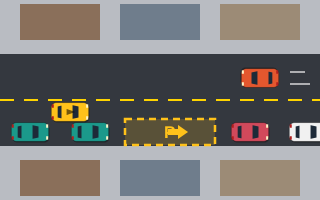
City Parking
City blocks with curbs, street parking and light moving traffic. Park before the timer ends.
Parallel Parking puts you on a street with a curb along one side and a line of parked cars. Your job is to slot into the gap between a front and a rear car, and that gap gets shorter on each of the five levels.
Touch, or click and hold the buttons. Keyboard: W A S D or the arrow keys.
| W / ↑ | Accelerate |
|---|---|
| S / ↓ | Brake — keep holding when stopped to reverse |
| A / ← · D / → | Steer left · steer right |
| Space | Brake (never reverses) |
| P / Esc | Pause / resume |
| R | Restart the level |
| C · M | Camera follow/overview · sound on/off |
| Touch / mouse | Hold ◀ ▶ to steer, GAS to accelerate, BRAKE / REV to brake and reverse |
Fit the car into the space between the parked car ahead and the parked car behind, along the curb. The bay requires your nose to point in the direction of the lane, so you finish facing the same way as the row of parked cars.
All four corners must be inside the bay, the heading within 12°, and the car held nearly still for about half a second.
Levels: Five street levels in which the gap between the front and rear parked cars shrinks each time, leaving less room to swing in.
The level score is +500 for parking, accuracy × 3 (up to +300), +10 for every second under par, and −100 for each collision, never below 0. The curb counts as a collision just like the parked cars, so a bump while straightening costs the same 100 points.
This is arcade scoring for a game; it is not driver training or a judgment of real parallel parking.
Full breakdown: how parking game scoring works.
These are gameplay tips for this arcade game, not real-world driving advice. More in Parallel Parking Games.
City blocks with curbs, street parking and light moving traffic. Park before the timer ends.
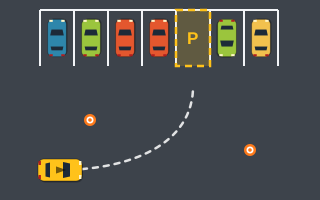
Five open-air lot levels with parked cars, cones and par times. Park clean and beat the clock.
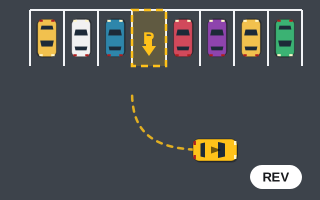
Every bay is reverse-in. Five levels of backing into spaces as the neighboring cars close in.
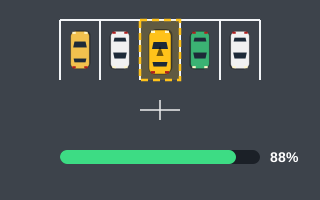
A hard game for neat parkers: 8° tolerance and accuracy targets that rise from 50% to 80%.
A complete guide to parallel parking arcade games: how the curbside bay works, the reverse S-curve that fits shrinking gaps, and City Parking with traffic.
A practice plan for reversing in parking games: five drills to tame the flipped steering, then stage-by-stage goals from Reverse Parking to Perfect Park.
A plain-English look at bicycle-style steering in arcade parking games: why cars only turn while moving, turn tighter when slow, and swing oddly in reverse.
The bay requires the nose to point in the direction of the lane. If you finish facing the other way, the park will not count.
The game only checks where the car ends up. Reversing in is usually easiest because the rear swings in and the front follows, but any approach that ends with the nose pointing along the lane works.
Yes. The curb counts the same as a parked car: one collision per contact, 100 points off, and a small bounce back. A short cooldown stops a single scrape from counting several times.
No. It is an arcade game with simplified physics, not driver training. Real parallel parking follows local rules and is best learned with professional instruction.
Stored only in this browser.