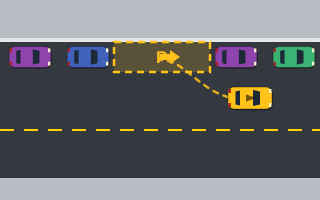
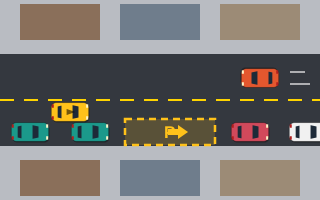
Parallel parking arcade games ask you to slide your car into a gap between two parked cars along a curb, ending up parallel to the road and facing the same way as the lane. On Play Parking, the dedicated game is Parallel Parking: five street levels where the gap between the front and rear car gets shorter each time. City Parking adds street parking on city blocks with light moving traffic.
What makes parallel parking its own challenge is geometry. The space is long and shallow instead of deep and narrow, and there's a curb on one side that counts as an obstacle. This guide explains how the levels are set up, the maneuver that reliably fits, and how to handle the smallest gaps.
How the street levels are laid out
Each Parallel Parking level has the same ingredients:
- A curb and sidewalk along one side of the road. Touching the curb counts as a collision, just like touching a car.
- A line of parked cars against that curb.
- A gap between a front car and a rear car, with the bay painted inside it.
- A direction requirement: the bay wants your nose pointing the way the lane runs, so you can't finish facing backward.
The standard success rule still applies. All four corners of the car must be inside the bay, the heading must be within 12° of the lane direction, and the car must be nearly stopped for the half-second "Hold…". With a long, thin bay, that 12° matters more than you'd think. A car sitting slightly diagonal will often have one rear corner poking out toward the road.
Why you reverse in
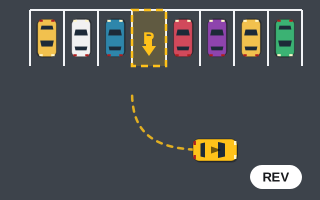
You can nose into a large gap on an early level. But as the gap shrinks, forward entry stops working, because the front wheels steer. Driving forward, the nose swings in but the tail follows on a wider arc and clips the rear car. Reversing flips that. The rear leads, so the tail can tuck into the curbside space while the nose follows it in.
Because the car turns more sharply at low speed, a slow reverse gives you the tightest possible arc. Reverse is also capped at roughly half of forward top speed, which buys time to correct.
The reverse S-curve, step by step
Here's the classic sequence adapted to the game's controls. The example assumes the curb is on your right; mirror the steering if it's on the left.
- Pull alongside the front car. Drive past the gap and stop beside the front parked car with a small side gap, your rear bumper roughly level with its rear bumper. Use Space to stop, because it never reverses.
- Reverse straight a little. Hold S or "BRAKE / REV" until you're rolling back slowly, then let the car travel a short way before turning.
- Swing the tail toward the curb. Steer right while reversing. The rear goes right, toward the curb, and the car angles into the gap.
- Straighten briefly. Once the car sits at a moderate diagonal and its rear is well inside the gap, release steering. The wheels self-center and you back straight for a moment.
- Counter-steer to bring the nose in. Steer left while still reversing. The tail swings away from the curb and the nose tucks in behind the front car.
- Straighten and settle. When you're parallel to the curb, stop. If you're too close to the rear car, a short forward roll will center you and nudge the accuracy up.
The counter-steer in step 5 is where most attempts fail. Start it too early and your nose clips the front car; too late and your rear corner rubs the curb. Watch the gap between your front corner and the front car's rear corner. Once your front corner has cleared it, counter-steer.
Handling the shrinking gap
By the later levels, the gap leaves little spare length. Some adjustments help:
- Start closer alongside. A smaller side gap at step 1 means less lateral distance to cover, so the S-curve can be shorter.
- Go even slower. Sharper turning at low speed means a crawl gives the tightest swing.
- Accept a two-part finish. It's fine to reverse in at a slight angle, then pull forward with the wheels turned toward the curb to straighten. Parallel Parking doesn't penalize direction changes. Only Perfect Park does that.
- Use the overview. Press C to see both parked cars and the curb together before you commit, then switch back to the Follow camera.
Scoring on a parallel level
Accuracy is 60% position and 40% angle. In a parallel bay the angle part is where points leak, since a car that's two or three degrees off still passes the 12° check but won't hit the 90% accuracy needed for "Perfect Park!". The live accuracy readout in the HUD shows while you overlap the bay, so creep forward or back a few pixels until it peaks, then stop. Each collision with the curb or a neighbor costs 100 points, which is a third of the maximum accuracy bonus. The full formula is in how parking game scoring works.
Parallel parking with traffic: City Parking
City Parking puts street parking on four city-block levels, with sidewalks, curbs and light traffic moving along the road. There's also a time limit. Two differences matter:
- The moving cars count as collisions. Wait for a car to pass before swinging your nose out into the lane in step 5.
- The timer makes the "start over" option expensive. Setting up well at step 1 saves far more time than rescuing a bad angle.
The traffic parking games page has more levels with moving cars if that suits you.
Parallel parking is mostly reversing, so it pays to get fluent with the flipped steering first. Our guide to mastering reverse parking in games has drills for exactly that, and the full parallel parking games category collects both curbside titles.