
Tight Parking
Very narrow bays, an 8° tolerance, reverse-in bays later on and a 3-collision limit.
In Reverse Parking there is no nosing in: every bay has an arrow pointing out of the space, so you have to back the car in. You start facing away from or past the bay, and the parked cars on either side get closer with each of the five levels.
Touch, or click and hold the buttons. Keyboard: W A S D or the arrow keys.
| W / ↑ | Accelerate |
|---|---|
| S / ↓ | Brake — keep holding when stopped to reverse |
| A / ← · D / → | Steer left · steer right |
| Space | Brake (never reverses) |
| P / Esc | Pause / resume |
| R | Restart the level |
| C · M | Camera follow/overview · sound on/off |
| Touch / mouse | Hold ◀ ▶ to steer, GAS to accelerate, BRAKE / REV to brake and reverse |
Reverse into the glowing bay on each of the five levels. Every bay shows an arrow pointing out of the space, and your car's nose must end up facing that way, so the rear has to go in first.
The park counts once all four corners are inside the lines, the heading is within 12° of the arrow, and you hold the car nearly still for about half a second.
Levels: Five levels of reverse-in bays, with the neighboring parked cars sitting closer to the space at each step.
Reverse Parking uses the standard level score: +500 for parking, accuracy × 3 for up to +300, +10 per second under par, and −100 per collision, never going below 0. Reach 90% accuracy or more and the level ends with Perfect Park! instead of Parking Complete!. Because reverse speed is only about half of forward top speed, a tidy setup usually saves more time than rushing the reverse.
The score is an arcade game mechanic only; it says nothing about how anyone parks a real car.
Full breakdown: how parking game scoring works.
These are gameplay tips for this arcade game, not real-world driving advice. More in Reverse Parking Games.
Very narrow bays, an 8° tolerance, reverse-in bays later on and a 3-collision limit.
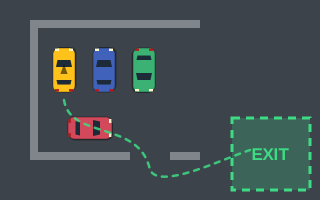
Start boxed in by cars and walls, then maneuver out to the green EXIT zone. No bay needed.
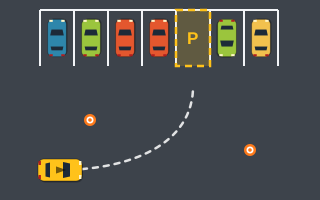
Five open-air lot levels with parked cars, cones and par times. Park clean and beat the clock.
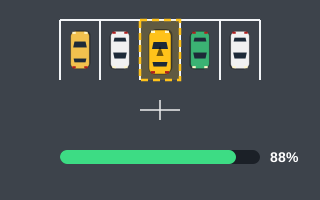
A hard game for neat parkers: 8° tolerance and accuracy targets that rise from 50% to 80%.
How reverse parking games work: what the bay arrow means, why steering feels flipped in reverse, and which Play Parking games make you back in to finish.
A practice plan for reversing in parking games: five drills to tame the flipped steering, then stage-by-stage goals from Reverse Parking to Perfect Park.
A plain-English look at bicycle-style steering in arcade parking games: why cars only turn while moving, turn tighter when slow, and swing oddly in reverse.
It is actually turning the way a reversing car does. The rear leads, so steering left swings the rear to the left while the nose moves the other way. It feels backward at first; focus on where you want the rear bumper to go.
No. Every bay in Reverse Parking has an arrow pointing out of the space, and the car's nose must face that arrow. Driving in forward leaves you pointing the wrong way, so the park will not count.
Press and hold BRAKE / REV. It brakes first, and if you keep holding once the car has stopped, it starts reversing. Steer with the ◀ and ▶ buttons while you roll backward.
Within 12° of the bay's arrow direction, with all four corners inside the lines and the car held nearly still for about half a second.
Stored only in this browser.