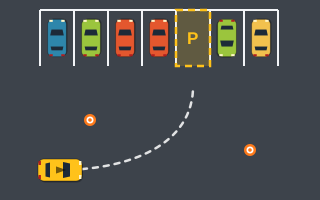
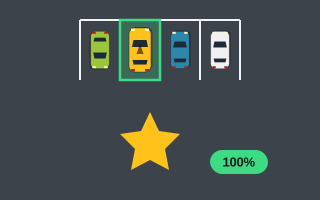
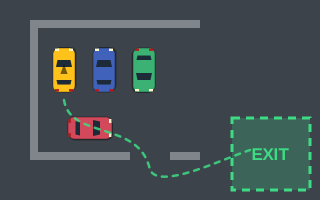
In Play Parking games, each completed level earns 500 points, plus your accuracy percentage multiplied by 3 (up to 300), plus 10 points for every second you finish under the level's par time, minus 100 for each collision. A level score can never fall below zero, and your run score is the sum of your level scores. A few games change the formula, and those differences are covered below.
Knowing where the points come from changes how you play. This guide walks through each part with worked examples, then shows which trade-offs are worth making.
The standard level formula
| Component | Points | Notes |
|---|---|---|
| Completion | +500 | Awarded for finishing the level. |
| Accuracy | + accuracy × 3 | Up to +300 at 100% accuracy. |
| Time bonus | +10 per second under par | Nothing extra if you finish at or over par. |
| Collisions | −100 each | One contact counts once, thanks to a short cooldown. |
The floor is zero. A messy level with many collisions scores 0, not a negative number, so it can't drag down the rest of your run.
What goes into accuracy
Accuracy is 60% position and 40% angle. Position measures how close your car's center is to the bay's center relative to the free space in the bay. Angle measures how close your heading is to the bay's direction. The HUD shows the live percentage while your car overlaps the bay, so you can see your accuracy bonus before you lock it in. At 90% or higher the result screen says "Perfect Park!" rather than "Parking Complete!". That label is a nice badge, but the points come from the percentage itself.
For techniques to raise the number, see our precision parking guide.
Three worked examples
The careful park
You finish a Parking Challenge level at 88% accuracy, 4 seconds under par, with no collisions.
500 + (88 × 3 = 264) + (4 × 10 = 40) − 0 = 804.
The fast but scrappy park
Same level, 72% accuracy, 12 seconds under par, 2 collisions.
500 + 216 + 120 − 200 = 636. Faster, but 168 points worse.
The slow perfectionist
96% accuracy, 5 seconds over par, no collisions.
500 + 288 + 0 − 0 = 788. Close to the careful park, and far safer than the scrappy one.
The exchange rates that matter
Putting the numbers side by side gives a set of rough equivalents worth memorizing:
- 1 collision = 10 seconds under par. Driving faster only pays if it doesn't cause contact.
- 1 collision ≈ 33 accuracy points. Nudging for accuracy is worth it only if the nudge is safe.
- 10% accuracy = 3 seconds under par. A deliberate final adjustment that takes a second or two usually pays off.
The takeaway is clear: avoiding contact is worth more than anything else you control. Speed and accuracy come second.
How runs add up
A run is a sequence of levels, and its score is the sum of each level's score. If you fail a level, whether from a countdown hitting zero or going over a collision limit, "Try Again" restarts that level only. The points you already banked for completed levels stay in the run.
Your best run score and best time are saved in your browser's localStorage. Nothing is uploaded, and there's no global leaderboard. Clearing your browser data will clear those bests. After a run you can share the result through your device's share sheet or use "Copy Result" to paste it anywhere.
Games with different rules
Parking Rush
Parking Rush is endless and runs on a 40-second countdown. Each successful park is worth 200 + accuracy × 2 points and adds time to the clock, starting at +8 seconds and shrinking to +4 seconds as you go. Every collision costs 2 seconds of clock rather than points. The run ends at zero, showing your total parks and score. Here, a quick 70% park that keeps the clock alive often beats a slow 95% park.
Perfect Park
Perfect Park uses the normal score, then subtracts 25 points for every switch between forward and reverse, plus a penalty for driving farther than the level's ideal route. The HUD shows your moves and distance. Four unnecessary direction changes cost as much as one collision.
Parking Escape
Parking Escape has no bay, so there's no accuracy term. Score is 500 + time bonus − 100 per collision, with a limit of 3 collisions. Speed and clean contact-free exits are the whole game.
Precision Parking
The formula is standard, but each level demands a minimum accuracy (from 50% up to 80%). Below it, the HUD shows "Needs X% accuracy" and the park doesn't count yet. That makes accuracy a gate as well as a bonus.
Strategy by goal
- Chasing a new best run: replay the fixed levels until the route is automatic, then shave time only on the sections where you never touch anything.
- Just finishing a hard game: ignore par. A slow zero-collision run still collects 500 plus accuracy on every level.
- Beating today's daily: the Daily Parking Challenge keeps a personal best for the day, so your first run sets a baseline for later attempts.
For how the scoring plays out in narrow bays with a 3-collision limit, read our tight parking tips. For a tour of the lot-based games where par times matter most, see parking challenge games.