The secret to tight parking games is to do all your aligning before the car enters the space. Once you're between two close neighbors there's almost no room to fix a bad angle, so a straight, slow, centered approach beats any clever correction. In Tight Parking, where the side margin shrinks from about 7 game units per side down to about 3, and the collision limit is just 3 per level, that principle is the difference between clearing a level and failing it.
Here are twelve specific tips, grouped by the stage of the maneuver where they help most.
Before you move
1. Scout with the overview camera
Press C to switch to the Overview camera and look at the whole layout. Note which side the neighbors crowd, whether the bay has an arrow, and how much open space there is in front of it. That open space is your turning room. Switch back to the Follow camera to drive.
2. Check the arrow first
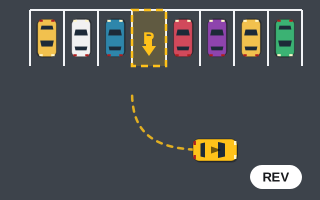
The later Tight Parking levels are reverse-in, with the arrow pointing out of the bay. Planning a forward approach and then discovering you need to back in wastes time and invites contact.
3. Budget your collisions
Tight Parking's collision limit is 3, and going over it fails the level. Treat the first contact as a warning, not a routine cost. Each one also costs 100 points, which is more than the gap between a 70% and a 100% accuracy park.
On the approach
4. Swing wide to arrive straight
The straighter the car is when its nose (or tail) crosses the bay line, the less correcting you'll do inside. Use the open lane in front of the bay to set up a wide arc, so your final few car lengths are a straight line into the space.
5. Turn at a crawl
The car turns more sharply at low speed than at high speed. In tight spots that's your best tool: a slower approach tightens the arc without any extra steering. If you keep overshooting the bay, you're almost certainly too fast.
6. Release steering to straighten
Steering self-centers when you let go. As the car comes in line with the bay, just release the key or button rather than tapping the opposite direction. Counter-steering at the last moment is a common way to clip a neighbor's corner.
7. Aim for the center line, not the gap
With only a few units of margin per side, aiming "somewhere in the space" isn't enough. Pick the bay's center line and line your car's center up with it. Position makes up 60% of accuracy and is measured relative to the free space, so in a narrow bay, centering is worth a lot.
Inside the bay
8. Respect the 8° limit
Tight Parking uses the stricter 8° angle tolerance. If the HUD shows "Angle off", don't steer on the spot, because the car can't turn while stopped. Roll a short distance out with a little steering, then come back in straighter.
9. Back out rather than scrape through
If one front corner is about to touch a neighbor, stop. Pushing on usually ends in a contact and a bounce that knocks the car crooked anyway. Hold reverse, pull back out a car length, and re-enter. Direction changes cost nothing in Tight Parking.
10. Brake with Space, not S
Space brakes without reversing, so you stop exactly where you are. Holding S a beat too long rolls the car backward, which in a narrow bay can drag a rear corner into a neighbor.
11. Hands off during "Hold…"
Once the HUD shows "Hold…", stop touching the controls. The car needs to stay nearly stopped for about half a second, and a nervous tap can start it moving.
Between attempts
12. Restart early and learn the level
If your approach is visibly wrong, press R and start the level fresh. It's faster than repairing a crooked entry, and it doesn't use up collisions. Each level in Tight Parking is fixed, so every restart teaches you the same approach a bit better.
Tight reverse bays in particular
The reverse-in levels combine every difficulty at once: narrow margins, the 8° tolerance and flipped steering. A few extra pointers:
- Remember that in reverse, steering left swings the tail left. Think about where the rear bumper needs to go.
- Stop past the bay before reversing, with your rear bumper beyond the far edge of the space. Starting level with the bay leaves no room for the tail to swing in.
- Reverse top speed is about half of forward speed. Use that extra reaction time rather than hurrying.
For a structured way to build that skill, see how to master reverse parking in games, and practice on Reverse Parking, where neighbors close in gradually across five levels.
Other games where tightness matters
| Game | Where it gets tight |
|---|---|
| Precision Parking | 8° tolerance plus minimum accuracy from 50% up to 80%. |
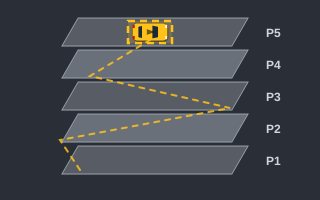
| Parking Tower | Tight pillars across 4–5 floors, with a time limit. |
| Parallel Parking | The curbside gap shrinks every level. |
| Parking Rush | Bays get tighter the longer the run lasts. |
If you're chasing points as well as completions, our guide to parking accurately explains how to push the accuracy readout higher, and how parking game scoring works shows why a slow, clean park almost always outscores a fast one with a scrape.