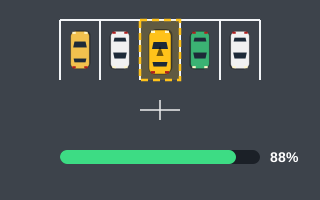
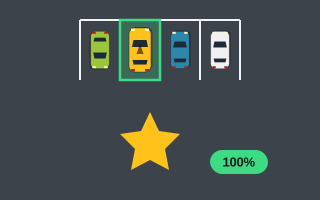
Precision parking games reward you for how well you park, not just whether you park. To score high you need to finish with your car's center close to the center of the bay and your heading almost perfectly aligned with it. On Play Parking that means working with the live accuracy readout, staying within a stricter 8° angle tolerance, and in Precision Parking meeting a minimum accuracy before the level will even accept your park.
This guide breaks down exactly how accuracy is measured, then gives a repeatable finishing routine for turning a "good enough" park into a high-scoring one.
How accuracy is calculated
Accuracy is a percentage made of two parts:
- Position, 60% of the score. How close your car's center is to the bay's center, measured relative to the free space available in the bay. In a roomy bay you have more slack; in a narrow one, a small offset costs more.
- Angle, 40% of the score. How close your heading is to the bay's direction.
Two practical conclusions fall out of this. First, centering matters more than straightness, so a dead-center car at a small angle will usually beat a perfectly straight car that is parked to one side. Second, you can't reach the top end on either part alone. For "Perfect Park!" you need 90% or more, and that takes both.
The readout appears in the HUD as soon as your car overlaps the bay, so you can watch the number respond to every nudge before you commit.
The 8° rule
Most games accept a finished park if your heading is within 12° of the bay direction. Three games tighten that to 8°: Precision Parking, Tight Parking and Perfect Park. Eight degrees is a small margin. If you roll into the bay on even a gentle diagonal, the HUD will read "Angle off" and the "Hold…" indicator won't start.
The fix is almost never to steer while stationary, which does nothing since the car only turns while moving. You have to roll a short distance, forward or backward, with a light steering input so the car pivots toward straight.
Minimum accuracy in Precision Parking
Precision Parking goes a step further. Each of its five levels sets an accuracy floor:
| Level | Minimum accuracy |
|---|---|
| 1 | 50% |
| 2 | 60% |
| 3 | 70% |
| 4 | 75% |
| 5 | 80% |
If you settle in the bay and pass every other check but fall short of the floor, the HUD says "Needs X% accuracy" and the level won't complete. You have to adjust. The quickest way is to identify which half of the score is weak. If you're straight but off-center, a gentle straight roll forward or back usually fixes it. If you're centered but angled, a tiny S-shaped roll (steer one way, then the other) straightens you without moving the center much.
A finishing routine that works
Line up before the line
Most of your accuracy is decided before your bumper crosses the bay entrance. Aim to be straight and centered on the bay's axis while you're still a car length away. Corrections inside a narrow bay are slow and risky; corrections outside are cheap.
Arrive at a crawl
Release the gas early and let friction carry you in. Low speed also means sharper steering response, so small taps have a visible effect.
Stop with Space
Space brakes without ever engaging reverse. Holding S to stop risks a slow backward drift that wipes out the position you just earned.
Read, nudge, read again
Look at the percentage. If it's short of what you want, make one small adjustment and look again. Resist making two corrections at once, or you won't know which one helped.
Then let go completely
Once the HUD shows "Hold…", take your fingers off every key or button. The car must stay nearly stopped for about half a second, and an accidental tap could get it rolling again before the hold finishes.
Precision is worth points everywhere
Even outside the precision games, accuracy feeds your score. Each level pays accuracy × 3, which is up to 300 points on top of the 500 for completing. The difference between a 70% park and a 95% park is 75 points. That's less than one collision (−100), which is why a careful, contact-free approach still comes first. In Parking Rush each park pays 200 + accuracy × 2, so the same habit pays there too. See our full scoring guide for worked examples.
Perfect Park: precision plus economy
Perfect Park adds two extra costs on top of the normal score: −25 points each time you switch between forward and reverse, and a penalty for distance driven beyond the level's ideal route. The HUD shows your move count and distance as you go. That changes the routine above. Instead of lots of small back-and-forth nudges, plan a single clean approach and make your final corrections in one direction only. Every avoided direction change is 25 points saved, and every extra loop of the lot costs distance.
Common precision pitfalls
- Chasing 100%. Past a certain point, each nudge risks a collision or, in Perfect Park, a direction-change penalty. Take the "Perfect Park!" at 90%+ and move on.
- Ignoring the free space. Position is judged relative to the room available, so in narrow bays a small offset hurts a lot. Center first.
- Correcting while fast. Steering is weaker at speed. Slow down before trying to straighten.
More general slip-ups are covered in common parking game mistakes. When you're ready for narrow bays on top of the 8° rule, read our tips for tight parking games, or browse every title in the precision parking games category.