Time-based parking games add a clock to the usual goal of settling a car cleanly inside a bay. On Play Parking, that clock shows up in two different ways: a countdown that fails the level when it hits zero, and a par time that pays a bonus for finishing early. Knowing which one you're facing changes how you should drive.
This guide breaks down both kinds of timer, explains how the endless mode in Parking Rush trades seconds back and forth, and gives practical ways to save time without paying for it in collisions.
Two kinds of clock: countdown vs. par time
Almost every level has a par time, even levels with no countdown at all. For each second you finish under par, the level awards 10 bonus points. Miss par and you simply get no time bonus; nothing else happens. A countdown is stricter. When it runs out, the level fails and you see "Try Again," which restarts that level while keeping the score from any levels you already completed in the run.
| Timer type | What happens when it runs out | Where you'll meet it |
|---|---|---|
| Par time | No time bonus, level still counts | Most levels, including Parking Challenge |
| Level countdown | Level fails, "Try Again" restarts it | Cone Parking, Parking Maze, Parking Tower, City Parking |
| Endless run clock | The run ends and your total parks and score are shown | Parking Rush |
The practical difference: under a par time, a slow clean park still earns the 500-point completion award and the accuracy points. Under a countdown, a slow clean park can earn nothing, because you never finish.
How Parking Rush turns time into a resource
Parking Rush is the purest timed mode on the site. You start with a 40-second countdown and one bay lights up at a time somewhere in the lot. Each successful park adds seconds back to the clock, starting at +8 seconds and shrinking toward +4 seconds as the run goes on, and pays 200 points plus accuracy × 2. Every collision costs 2 seconds. The run ends when the clock reaches zero.
That structure has a few consequences worth planning around:
- Early parks are worth more time. The first few bays refill the clock generously, so a calm, collision-free start builds a cushion you'll need later.
- A scrape is a quarter of a later refill. Once parks only add around +4 seconds, a single 2-second collision wipes out half of that gain. Late in a run, a slower but clean approach usually wins.
- Accuracy still pays in points, not time. A 95% park and a 70% park add the same seconds. If the clock is nearly empty, settle for "inside and still" and move on.
- Bays tighten as you go. Expect to slow down in the later stretch; that's by design, not a sign you're getting worse.
Countdown levels with obstacles
Several obstacle parking games pair a countdown with things you must drive around, which is where most time is actually lost.
Cone Parking
In Cone Parking, bays sit behind cone slaloms, gates and cone lines, and each cone you touch is a collision. The bounce-back after a hit also kills your speed, so one clipped cone costs points and time together. Take gates at a moderate speed rather than full throttle: the car turns more sharply at low speed, and a tight slalom rewards that.
Parking Maze
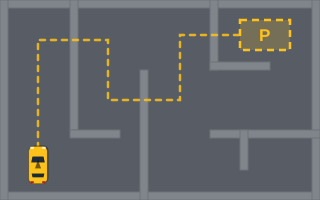
Parking Maze uses walled decks built from a fixed seed, so each level has the same layout every time you play it. That makes the countdown very learnable. On your first attempt, press C to switch to the Overview camera and trace a route to the bay in the far corner before you commit. Dead ends are the real time sink; a few seconds of planning beats a reverse out of a blind corridor. The parking maze guide goes deeper on routing.
Parking Tower and City Parking
In Parking Tower, the bay is always on the top floor, and the ramp on each floor alternates sides, so the clock is mostly spent climbing. In City Parking, light moving traffic can force you to wait. Waiting a second for a gap is almost always cheaper than a collision that bounces you back into the lane.
Where time actually goes
Most lost seconds come from a handful of habits rather than slow driving:
- Overshooting the bay and needing a direction change to come back.
- Stopping to fix the angle after you're already inside. Line up before you enter, when the car still has room to turn.
- Forgetting the hold. The car must stay nearly stopped for about half a second while the "Hold…" indicator fills. Creeping forward resets it.
- Driving the wrong way into an arrow bay. If the bay shows an arrow, the nose must point that way. Arriving backward on a forward-facing bay means a full turnaround.
Speed versus safety: a simple rule
Because a collision costs 100 points and a second under par is worth 10, one hit erases the bonus from ten seconds of fast driving. On countdown levels the math is harsher still, since a bounce can also leave you facing the wrong way. A good default is to drive quickly through open space, then brake early with Space or S before any tight spot. The scoring breakdown shows exactly how these numbers combine.
Daily practice against the clock
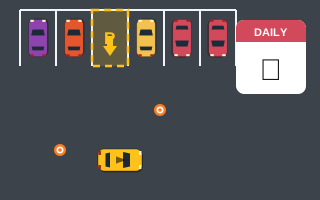
The Daily Parking Challenge generates a fresh layout each day from your device's local date, with a timer, accuracy readout and collision count. It keeps a personal best for today and an all-time best in your browser, so you can replay the same layout several times and watch your time drop as you learn it. It's a good way to practice reading a new lot quickly, which is the core skill in every timed mode.
If you keep running out of clock, check the most common parking game mistakes; a surprising amount of lost time comes from small, fixable habits. You can browse every timed game on the time parking games page.