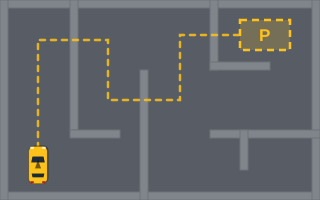
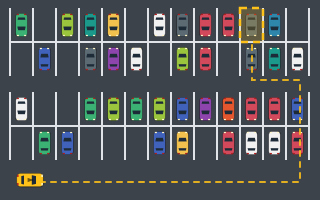
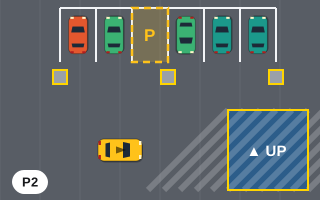
A parking maze game hides the parking bay at the end of a walled labyrinth. Before you can think about lining up, you have to find a route through corridors and around dead ends, usually against a clock. On Play Parking that game is Parking Maze: five levels of walled parking decks that grow from a 5×4 grid of cells to a 9×7 grid, each with a time limit and the bay tucked away in a far corner.
It sits in both the obstacle and time categories because it tests two things at once: planning a route and driving it cleanly. Here's how the mazes work and how to approach them.
How the mazes are built
Each level's layout is generated from a fixed seed. In practice that means the maze is identical every time you play that level. It isn't random per attempt. That changes the strategy completely: every attempt teaches you something permanent about the route, and memorizing it is fair play.
The key features:
- Walled cells. The deck is divided into a grid, with walls between some cells and openings between others. Walls count as collisions.
- Dead ends. Some corridors lead nowhere. Driving into one costs time, and getting out often means reversing.
- Growing size. Level 1 is 5×4 cells; by level 5 the maze is 9×7, with far more wrong turns available.
- A far-corner bay. The target is placed in a distant corner, so the route is long by design.
- A time limit. If the countdown hits zero, the level fails and "Try Again" restarts it.
Your two navigation tools
The Overview camera
Press C to switch from the Follow camera to the Overview of the whole area. In a maze, this is the single most useful key in the game. Before touching the gas, trace the path from your car to the bay with your eyes. Work backward from the bay if forward isn't obvious. Mazes are often easier to solve from the exit end.
Switch back to Follow for driving if you prefer a closer view, and tap C again at any junction where you're unsure.
The edge arrow
When the bay is off screen, an arrow at the screen's edge points toward it. In a maze, treat it with care. It points in a straight line, straight through walls. Following it blindly is the fastest way into a dead end. Use it as a compass for the general direction, and use the overview for the actual route.
Driving the corridors
Route-finding is only half the game. Corridors are narrow and every wall contact counts as a collision, costs 100 points and bounces you back while killing your speed. A few handling habits keep you moving:
- Slow into corners. The car turns more sharply at low speed. A 90° corner that looks impossible at speed is easy at a crawl.
- Hug the outside, then cut in. Enter a turn from the outer side of the corridor for a wider arc, so the tail doesn't clip the inside wall.
- Carry speed on straights. Long corridors are where you win back time. Accelerate hard, then lift off early so friction slows you before the next corner.
- Reverse out of dead ends. If you realize you're in a dead end, it's usually quicker to back out than to attempt a multi-point turn in a narrow cell. Remember that in reverse, steering left swings the tail left.
A level-by-level approach
| Levels | Maze size | What to focus on |
|---|---|---|
| 1–2 | Starts at 5×4 | Learn to read the maze from the overview and practice clean corner turns. |
| 3 | Mid-size | Plan the full route before moving; note one or two landmark turns. |
| 4–5 | Up to 9×7 | Split the route into sections and check the overview at each section break. |
On the larger mazes, a practical method is to memorize the route as a short list of turns, such as "right, left, left, straight to the end, right", rather than trying to keep the whole picture in your head.
The final approach
Once you reach the bay's corner, switch mindsets. The standard parking rule applies: all four corners inside, heading within 12°, nearly stopped, then hold for about half a second until "Hold…" completes. If the bay has an arrow, your nose must end up pointing that way. The final turn into the bay can be a tight one, so arrive slowly even if the clock is running down. A wall contact in the final meters costs more time than a careful crawl.
Using the fixed seed to your advantage
Because the layout never changes, your second attempt at any level should be dramatically faster than your first. Try this loop:
- First attempt: study the overview, drive carefully, reach the bay.
- Second attempt: drive the known route without stopping to check.
- Later attempts: look for places to carry more speed and brake later.
Finishing under par earns 10 points per second, so a memorized route pays twice: it keeps you inside the time limit and adds a bonus on top. Press R at any point to restart the current level if a run goes wrong early.
If you enjoy mazes, try these next
Parking Lot has a similar route-finding feel in large open lots with islands, and it's gentler to drive. Garage Parking adds floors connected by striped ramp zones, with the HUD showing your current and target floor. Cone Parking trades walls for cone slaloms and gates. You'll find more in the obstacle parking games category, and for a refresher on the basics see how to play parking games.