Obstacle parking games make the path to the bay the main challenge. Instead of an open lot with a clear run to your spot, you get cone slaloms, walled corridors or a car boxed in on all sides. The parking itself still follows the usual rules, but most of your mistakes will happen on the way there.
On Play Parking, three games sit in the obstacle parking category: Cone Parking, Parking Maze and Parking Escape. Each uses obstacles differently, so each asks for a slightly different approach.
How obstacles are treated by the engine
Every game on the site shares one engine, and in that engine an obstacle is anything solid: parked cars, walls, pillars, curbs, cones and moving traffic cars. Touching any of them counts as one collision per contact. A short cooldown stops a single scrape from registering several times, so dragging along a wall for a moment is one hit, not ten.
A collision does three things at once:
- It costs 100 points from that level's score.
- It bounces the car back slightly and bleeds off speed.
- On levels with a collision limit, it moves you one step closer to failing.
That bounce is easy to overlook. After a hit, the car is often slightly rotated and sitting further back than you expected, so the next input you had planned may no longer fit. Pause for a beat, look, then continue.
Cone Parking: threading gates on a timer
In Cone Parking, each of the five levels surrounds the bay with cone slaloms, gates and cone lines, and each level has a time limit. Cones are small, which tempts players to cut close. Because the car's turning circle is tighter at low speed than at top speed, the reliable way through a slalom is to drop speed before the first cone, steer while rolling, and only accelerate once the car points straight down the gap.
Cone lines that frame a bay behave like a narrow garage door. Line the car up well before the line, with the nose already pointed at the bay, rather than turning inside the gate. Turning inside a gate swings the rear corners outward, and that's where most cone hits come from.
Parking Maze: obstacles as navigation
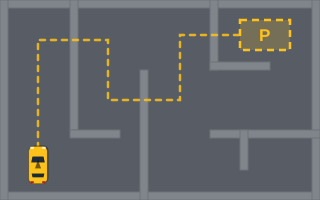
Parking Maze builds each level as a walled parking deck on a grid that grows from 5×4 cells to 9×7 cells. The layout comes from a fixed seed per level, so a level looks the same every time you play it. The bay sits in a far corner, dead ends are common, and a time limit runs throughout.
Here the walls matter less as things to scrape and more as things that block your view. A few habits help:
- Press C at the start to switch to the Overview camera and find the route before driving.
- Switch back to the Follow camera for corners, where detail matters more than the big picture.
- Take corners wide on entry and tight on exit, so the rear of the car clears the inside wall.
- If you hit a dead end, reverse straight out before turning. Turning while reversing in a narrow corridor swings the rear into the side wall.
The dedicated guide to parking maze games covers route-finding in more detail.
Parking Escape: obstacles you start inside
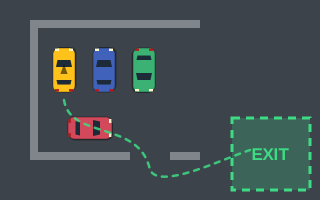
Parking Escape flips the usual setup. You begin boxed in by parked cars and walls, and the goal is to maneuver out and drive into a green EXIT zone. There is no bay, no accuracy score and no angle to match. Scoring is 500 plus the time bonus, minus 100 per collision, and every level has a collision limit of 3.
Because there's no accuracy to chase, the whole game is about clean, short moves. Escaping a tight box usually takes several small forward and reverse shuffles, each one rotating the car a little. Remember that the car only turns while it's moving, so you can't turn the wheels in place and then drive off; steer during each short roll. It's also why Parking Escape appears in the reverse parking games category: most exits begin with a careful backward move.
Reverse steering in a tight box
When reversing, the rear of the car leads. Steering left swings the rear to the left, which from the driver's seat makes the nose swing right. In a boxed-in start, that means the nose is the part most likely to clip the car beside you as you back out. Keep reverse moves short, and check the front corners as well as the back.
Comparing the three obstacle games
| Game | Main obstacle | Pressure | Goal |
|---|---|---|---|
| Cone Parking | Cone slaloms, gates, lines | Time limit per level | Park in the bay |
| Parking Maze | Walls and dead ends | Time limit per level | Reach and park in a far-corner bay |
| Parking Escape | Boxed-in start | Collision limit of 3 | Drive into the EXIT zone |
Skills that carry over
The same core skill shows up in all three: controlling where the corners of the car go, not just its center. Tight Parking trains the same thing inside the bay itself, with very narrow margins and its own collision limit of 3, and the tight parking tips apply directly to cone gates and escape boxes.
If the clock in Cone Parking or Parking Maze is what keeps beating you, read how time-based parking games work for ways to save seconds without adding hits.